+604 332 2335
sales@professional-tools.com
+604 332 2335
sales@professional-tools.com


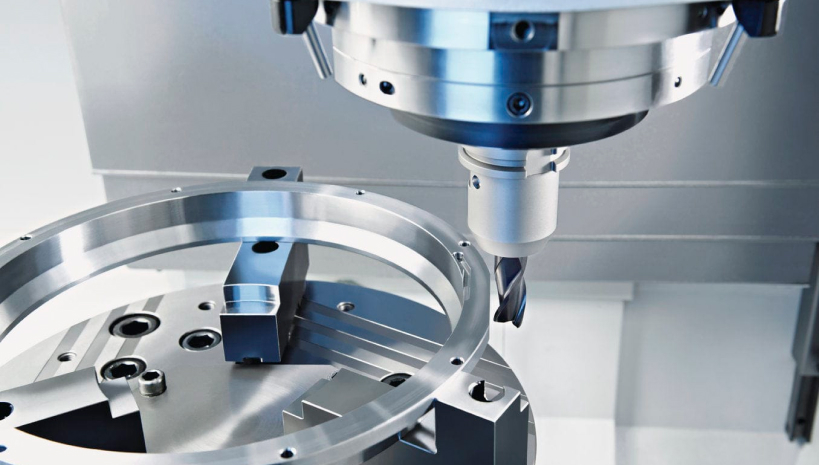
In most manufacturing facilities, jigs and fixtures are not the first topic discussed when reviewing production performance. Attention usually goes to machine capability, material quality or process parameters. However, in practice, the ability of a production line to deliver consistent and accurate parts over thousands or even millions of cycles often depend heavily on how well the workholding and guiding tools are designed and built.
In jigs and fixtures Malaysia applications, these tools form the infrastructure of repeatability. They allow a process to produce consistent results regardless of operator, shift or production volume. For manufacturers in Malaysia supplying industries such as automotive, electronics, medical devices and industrial equipment, the quality of fixture design is directly linked to production stability and output consistency.
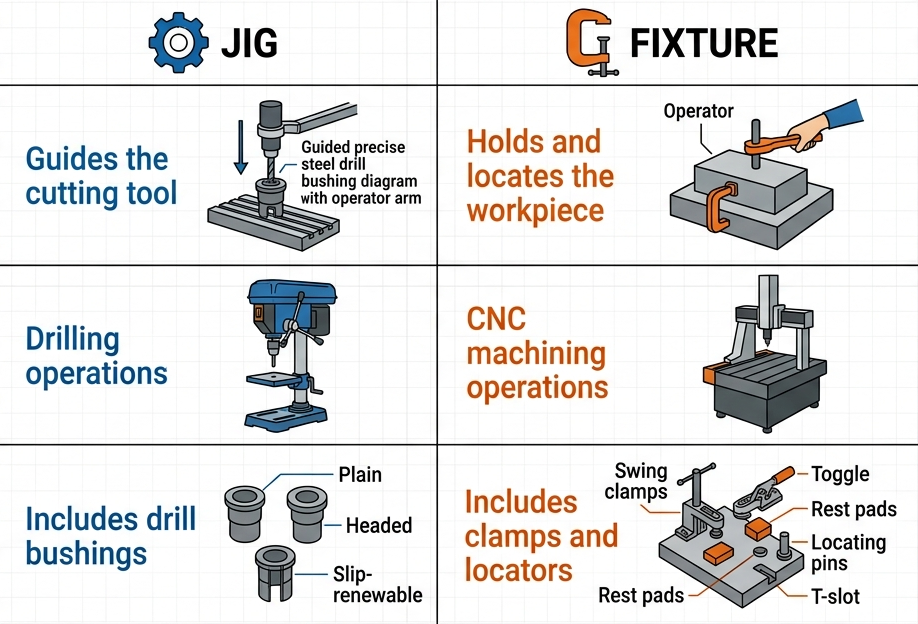
The terms jig and fixture are often used interchangeably, but they serve different functions.
A jig is a work-holding device that both locates the workpiece and guides the cutting tool to the correct position during machining. The guiding function is the key distinction. In drilling operations, a drill jig positions the part and guides the drill through a hardened bushing to help ensure the hole is produced within required tolerances and in the correct location.
A fixture, on the other hand, holds and positions the workpiece securely but does not guide the cutting tool. The tool path is controlled by the machine, such as a CNC program, robotic system or manual operation based on reference points. The fixture ensures the part remains stable and correctly oriented throughout the process. Common examples include welding fixtures, assembly fixtures and inspection fixtures.
In production environments, both are often used together. Jigs are applied where tool guidance is needed, while fixtures are used where stable and repeatable positioning is the priority.
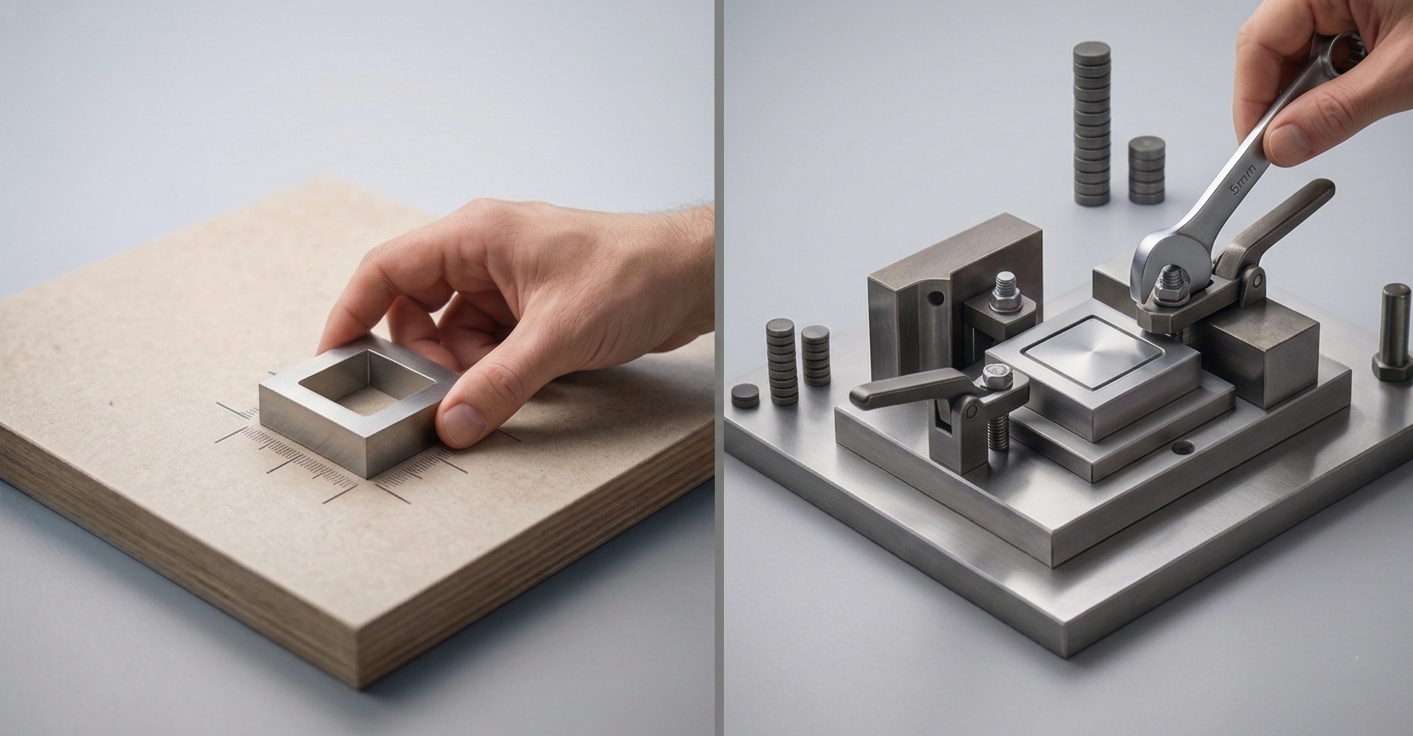
Without proper jigs or fixtures, operators must manually locate, align and clamp each workpiece before every operation. This increases setup time and introduces variation depending on skill, attention and experience.
On small production runs, this may be manageable. On high-volume production, small inconsistencies accumulate. Hole positions may drift slightly, weld points may shift and dimensional relationships between features may become inconsistent. Over time, parts that should be interchangeable may require adjustment or rework.
Well-designed jigs and fixtures reduce operator dependency for the critical aspects of the process. Locating features such as pins, reference surfaces and V-blocks establish a fixed relationship between the part and the machine. Once clamped, each cycle repeats under the same controlled conditions.
This supports part interchangeability, which is the ability to produce components that assemble consistently without additional fitting. Achieving this at scale in jigs and fixtures Malaysia manufacturing environments requires robust and well-engineered workholding systems.
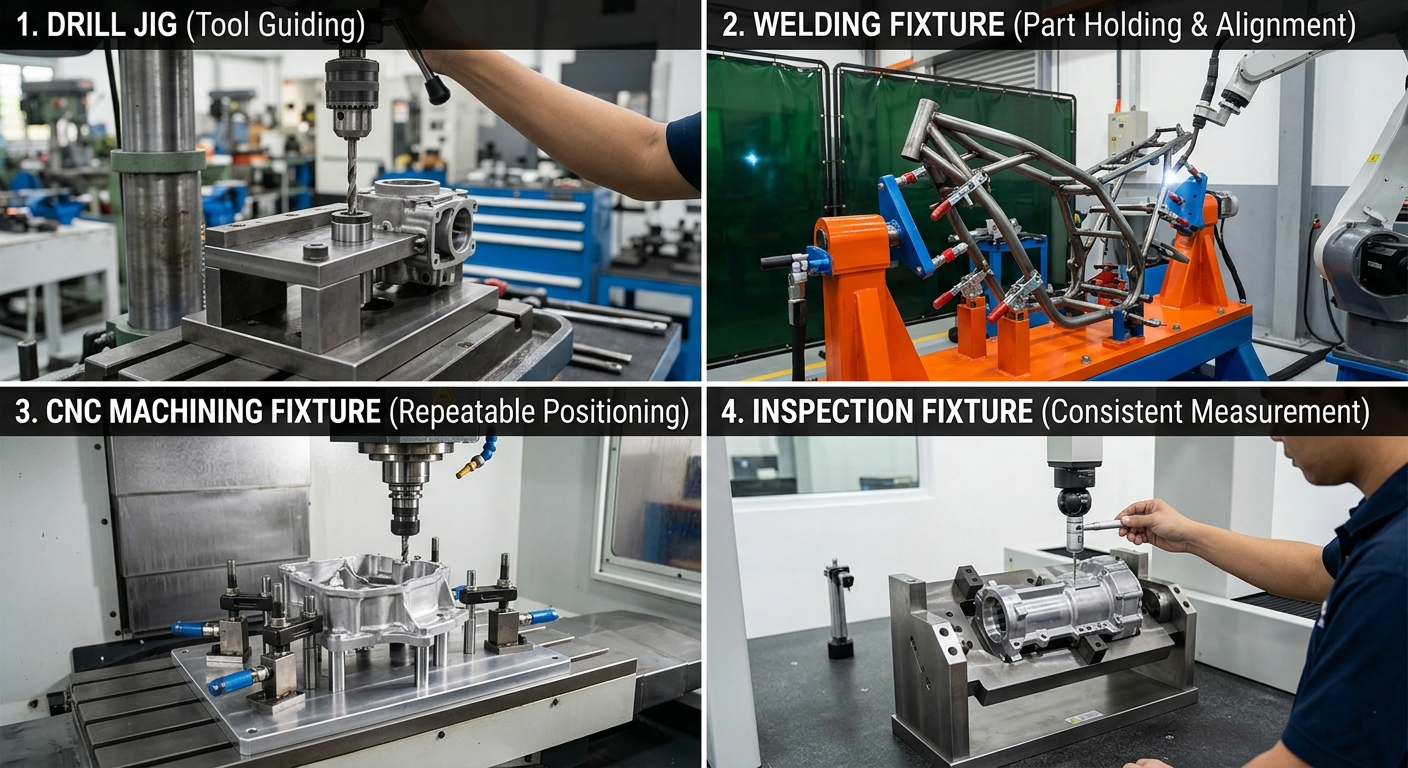
In machining processes such as drilling, reaming, tapping and milling, jig-guided workholding helps improve control over hole location and feature alignment.
With a drill jig using hardened bushings, variation is reduced within the combined capability of the machine, tool and fixture system.
This is closely related to CNC machining turning Malaysia, where stable workholding plays a key role in maintaining dimensional consistency across batches.
In welding operations, fixtures help control part alignment and reduce distortion caused by heat input.
During welding, heat causes expansion followed by contraction during cooling. Without restraint, this can lead to distortion and dimensional inaccuracy. A properly designed fixture holds the assembly in position throughout the process and helps control final geometry.
In automated environments such as robotic welding Malaysia, fixture repeatability becomes even more important. The robot follows a programmed path based on fixed coordinates. If the part is not located consistently, weld accuracy can be affected.
These principles are also applied in sheet metal fabrication Malaysia and sheet metal stamping Malaysia, where forming and joining processes depend heavily on accurate positioning and controlled force application.
In assembly processes, fixtures ensure components are joined in correct relative positions with controlled force and alignment.
Heat staking is commonly used in plastic assemblies. It involves pressing a heated tool onto a plastic feature to form a permanent joint. If the part is misaligned, the stake may deform incorrectly or create a weak joint. A fixture ensures correct positioning and consistent tool contact.
Fixtures are widely used in inspection processes to ensure consistent measurement conditions.
Inspection fixtures hold parts in a defined orientation so that measurements reflect actual part geometry rather than positioning variation. In manual inspection, this improves repeatability when using gauges. In CMM inspection, fixtures help present parts consistently to the measurement probe.
While CMM systems also use digital datum alignment, physical fixtures reduce the positioning variation introduced when loading each part onto the CMM table, which improves measurement repeatability and the reliability of data collected for SPC and process validation purposes.
In regulated industries, inspection consistency is important for validation and traceability. However, Statistical Process Control (SPC) does not strictly require fixtures. Instead, fixtures are commonly used to improve measurement system repeatability, which strengthens the reliability of SPC data.
Modular workholding systems are useful when part designs change frequently. However, for high-volume production, custom-designed jigs and fixtures usually deliver better performance.
In jigs and fixtures Malaysia manufacturing environments, custom tooling helps improve consistency, reduce cycle time and minimize operator dependency.
This is also critical in supporting upstream tooling such as mould & dies fabrication Malaysia, sheet metal stamping dies and precision production processes like fibre laser cutting Malaysia, where repeatability and accuracy directly affect downstream assembly quality.
When working with a jig and fixture supplier, design quality is just as important as fabrication quality. Even a precisely machined fixture may not perform well if the design logic is incorrect.
Key considerations include:
Fixtures should reference functional datums used in engineering drawings to ensure correct positioning.
Clamping should push the part against locating surfaces without causing deformation or movement.
The fixture must allow full access for machining tools, welding equipment or inspection probes.
Locating surfaces and pins should use hardened materials to maintain long-term accuracy.
For manufacturers aiming to improve consistency or reduce scrap, reviewing existing jigs and fixtures is often one of the most effective improvement steps.
Efficient design reduces cycle time and minimizes operator variation during setup.
In practice, fixture performance should always be evaluated as part of overall process capability. This includes machine accuracy, tool condition, workholding design, material behavior and operator method. Stable production outcomes depend on the interaction of all these factors, rather than any single component operating in isolation.
Professional Tools & Dies Sdn Bhd has been fabricating precision jigs and fixtures in Malaysia since 1990, serving customers in automotive, electronics, medical devices, semiconductor and industrial equipment manufacturing. Our fixture types include welding jigs for robotic and manual welding, CMM-compatible inspection fixtures, CNC machining jigs, heat staking jigs, parts holding jigs for spot welding, spinning, tapping and drilling and modular systems for quick changeovers between product variants.
Contact us to discuss your tooling requirements.
Poor fixture design often reveals itself through recurring dimensional variation, inconsistent weld positions, assembly fitment problems or high rejection rates despite stable machine settings. If operators frequently need to adjust part positioning, perform manual rework or troubleshoot alignment issues, the fixture may not be locating or clamping the part consistently. A fixture review can often identify opportunities to improve repeatability and reduce process variation.
Custom jigs and fixtures are usually justified when production volumes are high, quality requirements are tight or setup time has become a bottleneck. While standard workholding systems offer flexibility, custom tooling is designed specifically for the part geometry and production process. This often results in faster loading, more consistent positioning, reduced operator dependency and improved overall productivity.
Yes. One of the primary purposes of a jig or fixture is to ensure that every part is positioned consistently during machining, welding, assembly or inspection. By reducing variation between cycles, well-designed tooling helps minimise dimensional errors, alignment issues and process defects that can lead to scrap or rework. In high-volume manufacturing, even small reductions in defect rates can generate significant cost savings over time.
To develop an effective jig or fixture solution, suppliers typically require part drawings or CAD files, details of the manufacturing process, production volume, tolerance requirements and information about how the part will be loaded, clamped or inspected. The more complete the information provided, the easier it is to design a tooling solution that balances accuracy, ease of use, durability and production efficiency.
The lifespan of a jig or fixture depends on factors such as production volume, clamping frequency, material selection and maintenance practices. Components that experience repeated contact, such as locating pins, bushings and wear surfaces, may require periodic replacement. A properly designed fixture using hardened wear components can maintain reliable positioning accuracy throughout the expected production programme life when supported by preventive maintenance and regular inspection.
Disclaimer Statement
We hope you found this article informative. Our content is intended for general informational purposes only and does not constitute advice or necessarily reflect the full range of services offered by Professional Tools & Dies Sdn. Bhd.
Readers are advised to consult with a qualified industry professional and contact our experts for tooling’s recommendations specific to their individual project needs. While we strive for accuracy and completeness in our blog posts, we cannot guarantee they are error-free. Professional Tools & Dies Sdn. Bhd. assumes no responsibility for any errors or omissions.